
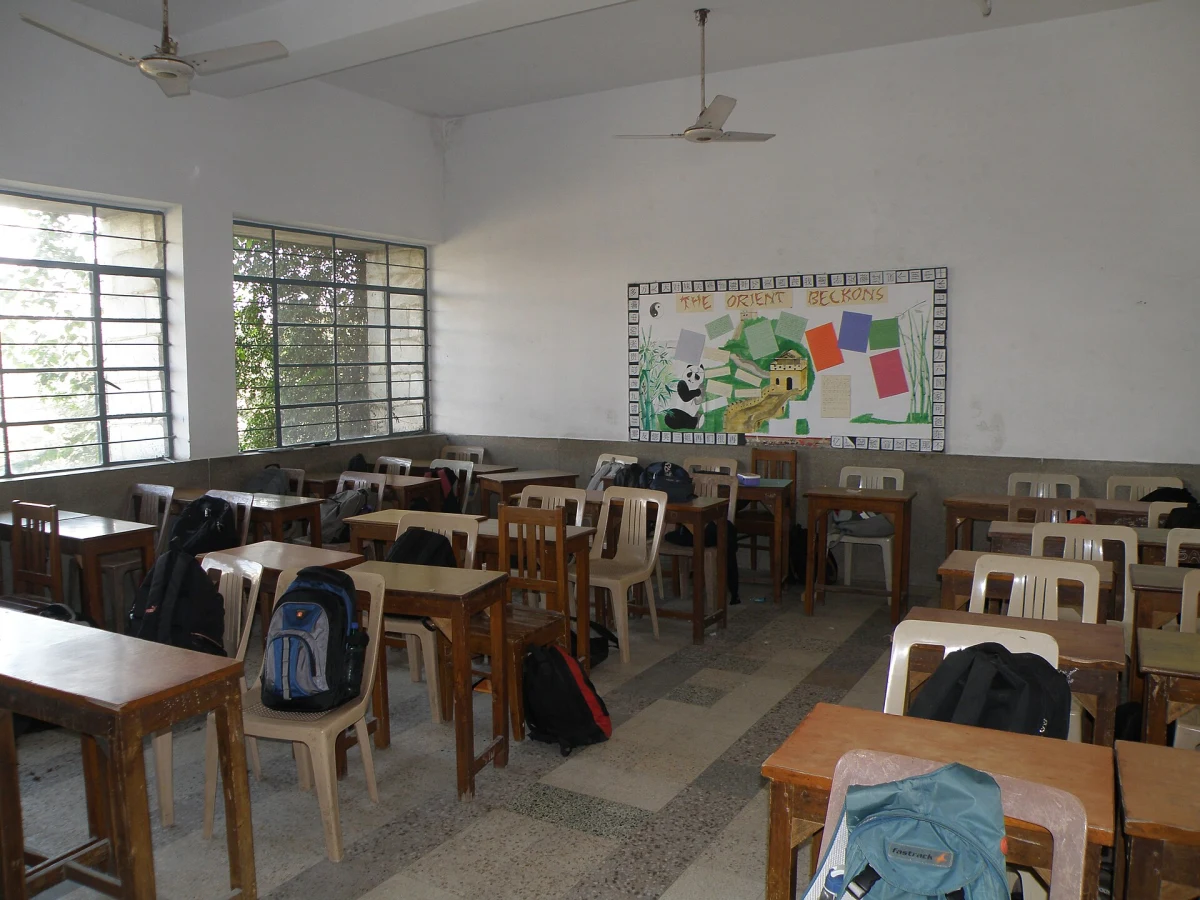
Every teacher knows the situation. You set a problem. Within two minutes a few students have finished and are looking around. Several are working steadily. And two or three have not yet begun, because they did not follow the instruction.
Advice on differentiation is plentiful and often assumes resources — teaching assistants, small groups, preparation time — that a teacher with a full timetable and forty students does not have. What follows are approaches colleagues at South Point English School have found practical under real conditions.
Start with the same problem, not different worksheets
Preparing three versions of every task is unsustainable, and it tends to lock students into the level you assigned them. A more workable approach is one task with depth available inside it.
Take a straightforward mathematics question: find the area of a rectangle with sides 8 cm and 5 cm. Every student can start. Then: how many different rectangles have an area of 40 square centimetres? Which of them has the smallest perimeter? Can you explain why that one does? Is it always true?
The same starting point now occupies students for very different lengths of time, at very different depths, with no additional preparation. The strong students are genuinely extended rather than simply given more of the same, and nobody is excluded from beginning.
This works across subjects. In science: what happened, why did it happen, what would happen if we changed one condition, how would you test that. In language: what does the passage say, how does it say it, why did the writer choose that way.
Check understanding before students work alone
Much of the gap that opens during independent work is not a gap in ability but a gap in having understood the instruction. Finding this out twenty minutes later wastes the twenty minutes.
Quick methods that cost little time:
- Ask for a signal. Thumb up, sideways, or down for how confident students feel. Not perfectly reliable, but it takes three seconds and catches the worst cases.
- Everyone answers one question on paper. Hold up the answers. You see the whole room at once.
- Have a student restate the task. If they cannot, others could not either.
- Circulate for the first three minutes rather than sitting down. Almost every misunderstanding is visible in that window.
Use the students themselves
A student who has just understood something is often better at explaining it to a peer than we are, because the difficulty is still fresh for them. We have stopped looking at the spread of ability in a class purely as a problem to be managed, and started treating it as a resource.
Two cautions from experience. Pair a student who has just grasped an idea with one who is close to grasping it, rather than pairing the strongest with the weakest — the gap in the latter case is usually too wide for either to benefit. And be clear that the explainer's job is to ask questions, not to supply answers, or it becomes copying with extra steps.
Give the early finishers something worth doing
“Read quietly” tells a capable student that finishing quickly is rewarded with nothing. Keeping a standing set of extension tasks on the board changes that:
- Write a question of your own on this topic, and its answer.
- Explain your method to someone who has not finished, without telling them the answer.
- Find a second way to solve it.
- Where might this go wrong? Construct a case where the method fails.
The third and fourth are particularly valuable, because finding an alternative method or a limiting case demands genuine understanding rather than speed.
Be careful with fixed groupings
Sorting students into permanent ability groups is administratively tidy and pedagogically risky. Students learn very quickly which group is which, and the label becomes an identity. A child who decides at eleven that they are “not a mathematics person” will act on that belief for years, and the belief does far more damage than any gap in prior knowledge.
Flexible grouping — different pairings for different tasks, changing week to week — achieves the pedagogical benefit without the permanent label. It is more work to organise and worth the trouble.
What to do about genuine gaps in foundations
Sometimes a student is not struggling with today's lesson but with something from three years ago. A Class 9 student who cannot work with fractions will find algebra impossible, and no amount of careful explanation of algebra addresses the real problem.
This cannot be solved inside a normal lesson, and pretending otherwise fails the student. What has worked at our school is identifying these cases explicitly, arranging short focused sessions on the specific missing foundation, and — importantly — involving parents so that the reason for the difficulty is understood at home rather than read as laziness.
It requires honesty about where a student actually is, which can be uncomfortable for everyone. It is considerably kinder than allowing them to fall further behind while appearing to keep up.
A final observation
The most useful shift in our own practice has been a change in the question we ask ourselves while planning. Not “what will I cover today?” but “what will every student in this room be able to do at the end that they could not do at the start?”
It is a harder question. It also tends to produce a better lesson.